

No. 1
Are Children's "Playgrounds" Disappearing? Preventive maintenance is an effective solution for overcoming budget constraints.
No.1.
Are Children's "Playgrounds" Disappearing? Preventive maintenance is an effective solution for overcoming budget constraints.
Are Children's "Playgrounds" Disappearing? Are Children's "Playgrounds" Disappearing?
“Preventive Maintenance” That Overcomes Budget Constraints “Preventive Maintenance” That Overcomes Budget Constraints
“That swing set in the park—it’s been there ever since I was a kid, hasn’t it?”
Have you ever found yourself having a conversation like that while at the park on a day off? The playground equipment we casually pass by has stood in the same spot for decades—through rain and wind—watching over the growth of local children across generations.
Playground equipment isn’t just a lump of iron or wood. They are “community educational infrastructure” where children first learn the rules of society, discover the joy of taking on challenges, and nurture bonds with friends. They are also irreplaceable “stages of memory” and “stages of play” shared across generations.
However, right now, in parks and facilities across Japan, these precious stages are quietly disappearing, swept away by a wave of “deterioration,” “budget shortages,” and “excessive risk aversion.”
In this first installment of the series, we’ll discuss the vision for a “Network to Protect Playgrounds”—which we must share to preserve Japan’s playgrounds in local communities—as well as “preventive maintenance,” a strategy for overcoming the biggest obstacle: “budget issues.”
In subsequent installments of this series, in addition to the Ministry of Land, Infrastructure, Transport and Tourism’s safety guidelines, we will also introduce the concepts behind “ISO 4980,” a standard that evaluates the value and safety of play from an international perspective. Let’s take a comprehensive look at playground safety measures from the perspectives of both domestic guidelines and international standards.
An era in which no one can fully ensure “children’s safety” on their own An era in which no one can fully ensure “children’s safety” on their own
I imagine that local government park officials, as well as administrators at educational institutions and private facilities, are driven by a strong sense of mission to “provide safe playgrounds for children,” yet they face daily challenges such as budget and staffing constraints, as well as the pressure of having to prevent accidents.
It is a sad reality, but we have entered an era where it is no longer possible to ensure the safety of all playground equipment through the efforts of “local governments alone,” “schools alone,” or “facility administrators alone.” That is precisely why what is needed now is not isolated management, but the creation of a “Network to Protect Playgrounds” where knowledge and information are shared and we support one another.
A manager shares a near-miss incident that occurred at a park; a specialized maintenance contractor repairs it using proven techniques; and local residents keep a watchful eye. Only through a platform where “the expertise of specialized contractors” and “the watchful eyes of managers and the community” intersect can we truly ensure children’s safety.
The Biggest Obstacle to Our Vision: The Vicious Cycle of “Demolition” The Biggest Obstacle to Our Vision: The Vicious Cycle of “Demolition”
However, when we set out to achieve this vision, a major obstacle stands in our way: “budget shortages.” The playground equipment installed en masse between the 1970s and 1990s is now becoming dilapidated. Amid tight fiscal conditions, many sites are caught in the following vicious cycle:
● [Budget Shortages] → [Inspections Becoming a Formality, Problems Left Unaddressed] → [Serious Hazards Arising] → [Use Prohibited or Equipment Removed] → [Loss of Playgrounds, Decline in Community Appeal]
Saying, “We’re removing it because it’s dangerous and we don’t have the money,” is nothing more than a temporary postponement of risks and costs. Parks where playground equipment has disappeared lose their vitality. We must now undergo a paradigm shift from passive management—which involves “removing things because they’re dangerous”—to proactive maintenance—which involves “maintaining safety so the equipment can continue to be used.”
From “Reactive Repair” to “Preventive Maintenance”: The Key to Solving Budget Issues From “Reactive Repair” to “Preventive Maintenance”: The Key to Solving Budget Issues
So, given the reality of “insufficient budgets,” how can we maintain playground equipment? The ultimate answer lies in shifting to “preventive maintenance” with a focus on LCC (Life Cycle Cost).
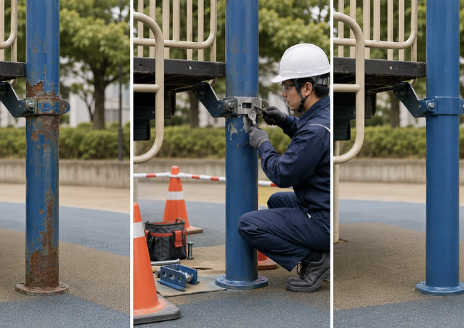
Preventive maintenance means identifying minor changes early through inspections and taking necessary action before damage spreads, rather than waiting until the equipment suffers major breakdowns. For example, replacing an entire piece of playground equipment with a brand-new one after it breaks is very costly, but performing partial repairs or repainting while rust and wear are still minor can significantly extend the equipment’s lifespan.
The Ministry of Land, Infrastructure, Transport and Tourism’s safety guidelines also recommend extending the lifespan of playground equipment by preventing deterioration through measures such as repainting, as well as implementing planned renovations to ensure its continued use.
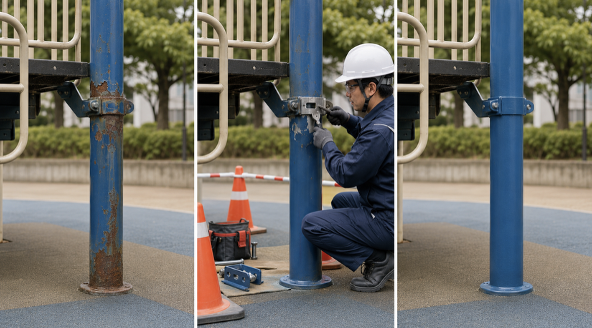
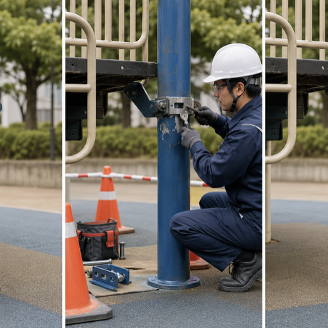
Flowchart of “Preventive Maintenance” from Inspection to Repair (Generated Image) Flowchart of “Preventive Maintenance” from Inspection to Repair (Generated Image)
“Small Cues” from Playground Equipment “Small Cues” from Playground Equipment
The starting point of preventive maintenance is noticing small changes that appear in playground equipment.
● Rust has appeared at the base of a post where there wasn’t any before
● When you swing the swing, it makes a different sound than usual
● Bolts or metal fittings appear to be loose
While these changes may not necessarily lead to a serious accident right away, they could be signs from the playground equipment saying, “Please check its condition.”
While there are changes that only managers who inspect the equipment daily can notice, there are also issues—such as internal corrosion or structural problems—that cannot be detected without specialized knowledge or equipment. The Japan Park Facilities Association (JPFA) also recommends consulting with a professional technician and taking prompt action if any abnormalities are found during routine inspections.
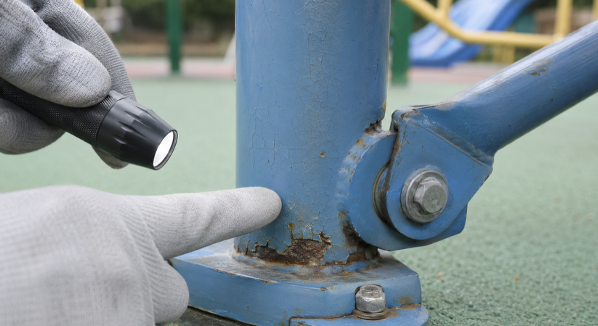
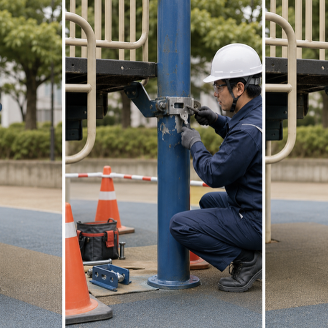
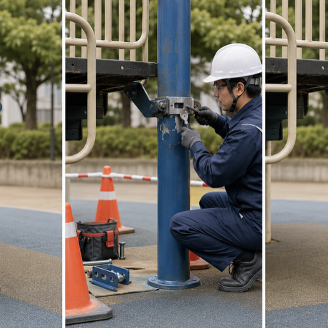
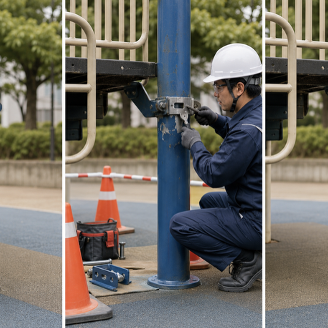
“Preventive Maintenance” Starts with Inspections by Experts (Generated Image) “Preventive Maintenance” Starts with Inspections by Experts (Generated Image)
To Preserve Play Spaces in Our Community To Preserve Play Spaces in Our Community
While juggling their daily duties, many facility managers likely find themselves wondering, “Is this rust still okay?” “Should we repair or replace it?” and “Where should I start looking for expert advice?”
Playground equipment safety is not a burden that should be shouldered by a single person. When “the manager’s watchful eye,” “inspections by technical experts,” and “the technical expertise of manufacturers and repair contractors” come together in a collaborative system where experts and managers support one another, it creates the potential for playground equipment to be used more safely and for a longer period of time.
On the books, the costs of inspections and repairs may be listed as “maintenance expenses.” However, what these costs protect is the time children spend moving their bodies, taking on challenges, and playing with friends. The beaming smiles on children’s faces when they swing with all their might on a swing, enveloped in the exhilaration of feeling as if they might soar into the sky, and the confidence they gain from pushing beyond their limits—these are the sources of “vitality” that can never be obtained in the virtual world, no matter how much digital technology advances.
Securing a budget for “preventive maintenance” is not merely a matter of “maintenance costs.” It is an extremely valuable “investment in the future” that creates opportunities for children’s growth and helps rebuild the bonds of the local community. To preserve these “playgrounds” for children in our communities, why don’t we gradually shift our approach from “fixing things after they break” to “protecting them before they break”?
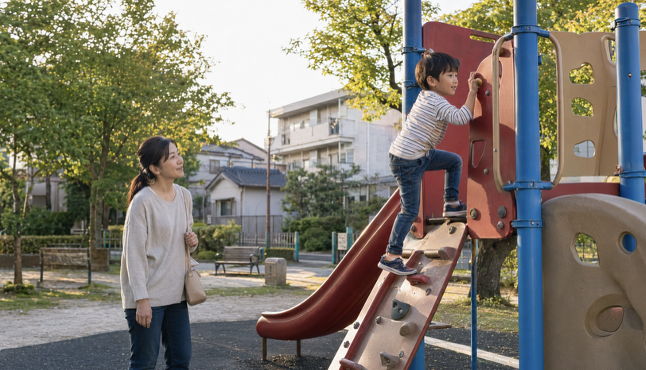
To Preserve Our Precious “Playground” (Generated Image) To Preserve Our Precious “Playground” (Generated Image)
INFORMATION
Plofile Plofile
Author of this article: Ryuta Otsubo (Representative, Playground Safety Network / IBRA) Author of this article: Ryuta Otsubo (Representative, Playground Safety Network / IBRA)
An expert in park management who uses benefit-risk assessment (BRA) to distinguish between “risks” necessary for children’s growth and development and “hazards” that should be eliminated. Based on guidelines from the Ministry of Land, Infrastructure, Transport and Tourism and ISO 4980 (BRA), he conducts outreach and awareness-raising activities regarding BRA for local governments and facility managers nationwide. An expert in park management who uses benefit-risk assessment (BRA) to distinguish between “risks” necessary for children’s growth and development and “hazards” that should be eliminated. Based on guidelines from the Ministry of Land, Infrastructure, Transport and Tourism and ISO 4980 (BRA), he conducts outreach and awareness-raising activities regarding BRA for local governments and facility managers nationwide.
INFORMATION
Information Information
[Supporting Safety Management at Playgrounds: Information on Specialized Consultation Services] [Supporting Safety Management at Playgrounds: Information on Specialized Consultation Services]
“I don’t know where to start when it comes to playground safety measures.” If that’s how you feel, why not begin by having a professional assessment to create a “report” (to assess the current condition)?
Furthermore, to ensure successful preventive maintenance, “professional expertise”—based on a thorough understanding of JPFA (Japan Park Facilities Association) standards—is essential.
Through this website’s expert consultation service (operated by KTS), professional expertise—including the early detection of hidden hazards, “partial repairs” that comply with standards, and rust prevention and repainting to extend service life—ensures “longer service life.” We are always available to assist you in assessing the current condition of your facilities and consulting on a “preventive maintenance plan” designed to extend their service life. Please feel free to contact us through our inquiry form.

